
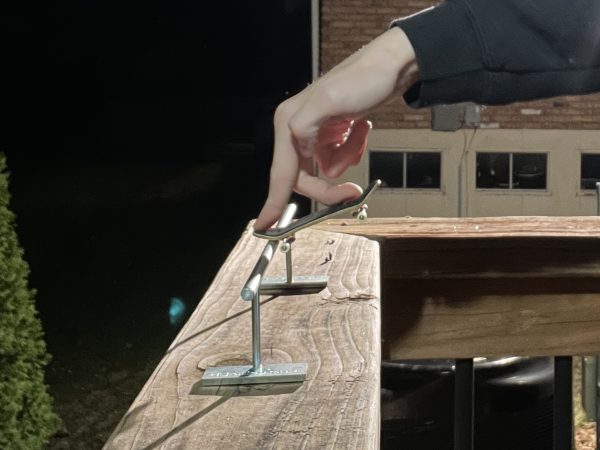
As said by Parkway Central Junior Everette Gatesh, in its simplest terms, a fingerboard is “a miniature skateboard to play with, with your fingers,”. Just like a Tech Deck you may remember playing with when you were little, a fingerboard consists of a deck, wheels, and trucks to attach the wheels to the deck. Unlike Tech Decks, fingerboards usually feature a wooden deck made of multiple plies of wood molded together with bearing wheels and pivoting metal trucks. A fingerboard often uses foam griptape instead of sandpaper griptape to improve grip.
Fingerboarders are able to recreate almost any trick performed on a real skateboard with fingers. To get the fingerboard off the ground, you must perform what is known as an ollie. An ollie is done by pressing the back, or the tail, of the fingerboard against the ground with your back finger while simultaneously sliding your front finger forward toward the front, or nose, of the board. The first trick a fingerboarder learns is usually a pop-shuv, where the board does a 180° clockwise rotation along its x-axis. The first flip trick a fingerboarder learns is often a kickflip, where the fingerboard does a counterclockwise barrel roll in the air. You can also perform a clockwise barrel roll on a fingerboard, called a heelflip. After learning these simple tricks, a fingerboarder is able to combine these techniques to perform tricks like 360 flips, where the board simultaneously performs a kickflip and a 360° pop-shuv. A laser flip is the opposite, where the board does a heelflip and a 360° frontside pop-shuv simultaneously.
Just like skateboarding, fingerboarders will often include obstacles such as ledges or rails into their combos to perform what is known as a grind trick. A 5-0 grind is done by balancing the board along an obstacle on its back truck only. A nosegrind is the opposite, performed by balancing on the front truck only. A boardslide is done by performing a 90° rotation with the board and sliding along the obstacle on the middle section of the board. A noseslide and tailslide are similar, but performed by sliding along the nose or tail of the board rather than the middle section.
Although a fingerboard may seem like a gimmick or a novelty, the hobby has a rich history rooted in the early days of skateboarding. The history of fingerboarding dates back to the 1970s, with people performing skateboard tricks on miniature skateboard keychains. In 1985, Powell Peralta released a skate video titled “Future Primitive”, in which famous skateboarder Lance Mountain can be seen shredding a sink with a fingerboard made of popsicle sticks and toy car wheels. This is regarded as the first widely seen fingerboarding footage. In 1998, the toy company X Concepts revolutionised fingerboarding by releasing the Tech Deck, which launched fingerboarding into the mainstream. Since then, it has grown into a popular hobby enjoyed by many around the world, creating a dedicated community of fingerboarders.
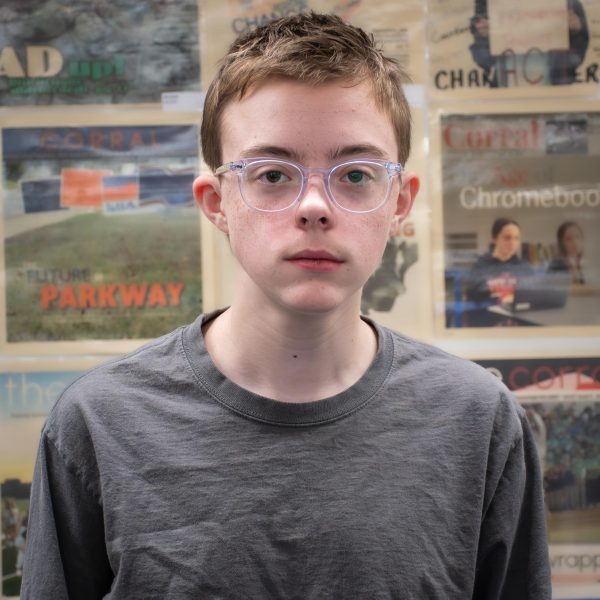
Everette Gatesh is one of those fingerboard enthusiasts. Gatesh discovered fingerboarding at a young age and was immediately intrigued.
“I saw YouTube videos about it when I was younger, and it looked fun, so I wanted to do it too,” Gatesh said.
Watching other fingerboarders perform tricks with the board sparked a curiosity in Gatesh to start fingerboarding himself. He began practicing with his own Tech Deck and slowly started becoming better and better. Fingerboarding gave him a fun challenge and became something to pass the time with.
“I like it because it’s fun. It gives me something to do.” Gatesh said.
Fingerboarding has become more than just a hobby for Gatesh. Fingerboarding has also helped create meaningful friendships.
“I also got close with my friend because of fingerboarding.” Gatesh said.
Practicing tricks and filming videos together created a bond that strengthened their friendship. This social aspect of fingerboarding is a part of what makes fingerboarding so appealing. Fingerboarding can be done at home or online, but it can also be done in person, bringing people together over a shared interest.
Social media has played a major role in the spread of fingerboarding, starting in the early 2000s with fingerboarding forums. Fingerboarders from around the world were able to talk and connect on these internet forums, creating a larger and stronger community of fingerboarders around the world. Even now, social media is still playing a large part in the continued popularity of fingerboarding.
“[There’s] constantly fingerboarding on people’s feeds. I think as long as social media is still a thing and people are still posting fingerboard content, then it’s just going to keep growing,” Gatesh said.
Social media platforms like Instagram and Tiktok are the most popular for fingerboarders, with some users amassing hundreds of thousands of followers across these platforms.
From the early days of keychain fingerboards to the current days of professional fingerboards, fingerboarding has cemented itself as a popular hobby enjoyed by many around the world. To many people like Gatesh, fingerboarding is more than a hobby. It’s a way to connect with like-minded individuals and truly be creative. As fingerboarding continues to grow, it inspires new enthusiasts to pick up the hobby and build those close bonds like Gatesh and many others.